
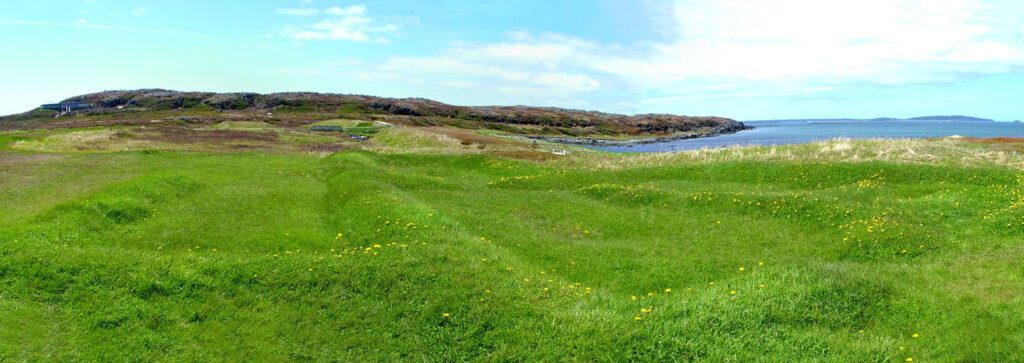
In the article Vinland — Vikings in North America, we briefly talked about L’Anse aux Meadows. It’s a UNESCO heritage site in Newfoundland, found by husband and wife archaeologists Helge and Anne Stine Ingstad in 1960.
To this day, it’s the only confirmed Viking site in North America. Migrating down from Greenland, it’s thought that a lack of supplies and high tensions with the Natives forced them to leave before they could establish a colony.
Check out this short video by Canada C3 on YouTube to introduce L’Anse aux Meadows.
For more information on L’Anse aux Meadows, head on back over to that other article.
L’Anse aux Meadows dated to AD 1021
Now, there’s a very exciting new development.
We always knew that L’Anse aux Meadows was inhabited by Viking sailors approximately 1,000 years ago. The remains strongly resemble findings in Greenland and Iceland from about the same period.
Now, though, scientists have managed to date the settlement’s construction to exactly AD 1021 — precisely 1,000 years ago at the time of writing.
Available to read in Nature, published 20 October 2021, the research concludes this exact year through analysis of tree rings.
In the year AD 993, there was a huge solar storm, leading to a huge “upsurge in atmospheric radiocarbon concentrations” (see the research paper’s introduction). This solar storm left imprints in the tree rings.
By analysing the deposits left by the solar storm, scientists can tell — to a high degree of accuracy — when the tree was cut down.
Tree rings (not from L’Anse aux Meadows). Photo by Denis Agati on Unsplash
The study of tree rings (or dendrochronology) was combined with a little astrophysics and carbon dating. After carefully peeling the bark back from three pieces of wood taken from L’Anse aux Meadows, they found that, on all three samples, the 28th ring in from the outside contained considerably more radiocarbon than any others.
Since one tree ring represents a year of the tree’s life, we know that a significant cosmic event happened 28 years before the tree was cut down.
After ruling out other earlier and later events (known as Miyake events), the AD 993 solar storm was the only viable date. And 28 years after AD 993 is… AD 1021.
For more in-depth information about the entire process, check out the paper. There’s a link at the start of this section.
Why is this important?
Narrowing down the date that the Vikings established their North American settlement will help various other pieces of the broader puzzle fall into place.
How did they cross the Atlantic? Why did they come? Who led them? What happened when they arrived? And why exactly did they have to leave?
So far, all we have is speculation around those questions. But the picture is building, and a more precise date gives us that little bit more of a clearer image.
Watch this space.
How we view the Vikings
It’s the fault of every age of humankind that they consider themselves to be the best, and better than any other people that have come before them. Currently, that fault lies with us.
We consider ourselves, especially in the western world, to be an advanced civilisation, far beyond the understanding and capabilities of people from times gone by. To some extent, it’s true. Technology has advanced exponentially over the last 200 years, with the knowledge curve hitting ridiculous levels.
However, Vikings crossed the Atlantic — a feat we thought was only accomplished by Columbus in 1492. He’s still widely regarded as the first European to cross the Atlantic and reach the New World.
As the evidence fairly clearly shows, Columbus was at least second. By 471 years. That’s pretty late, to be fair.
The Vikings travelled the world in the Middle Ages. The Dark Ages, as we often refer to them, ended in the year AD 1000. How laughable that we often view these people as simple peasants! — and ignore the highly advanced skills and civilisations they created.
History is more dependent on our view of it than it is on fact. In today’s world of information exchange, that should be changing. But it’s not yet.
Suffice it to say, the Vikings — led by person or persons unknown, as yet — were the first that we know of to reach the Americas from Europe. They were travellers, warriors, settlers and farmers — the stuff of legend and dramatic tales.
Who knows? Other than the Natives, perhaps someone beat even the Vikings!
We have yet to find out.